The Age I Share With Gandhi
I have found myself less interested in shared birth dates and more drawn to noting my age as it relates to fallen heroes.


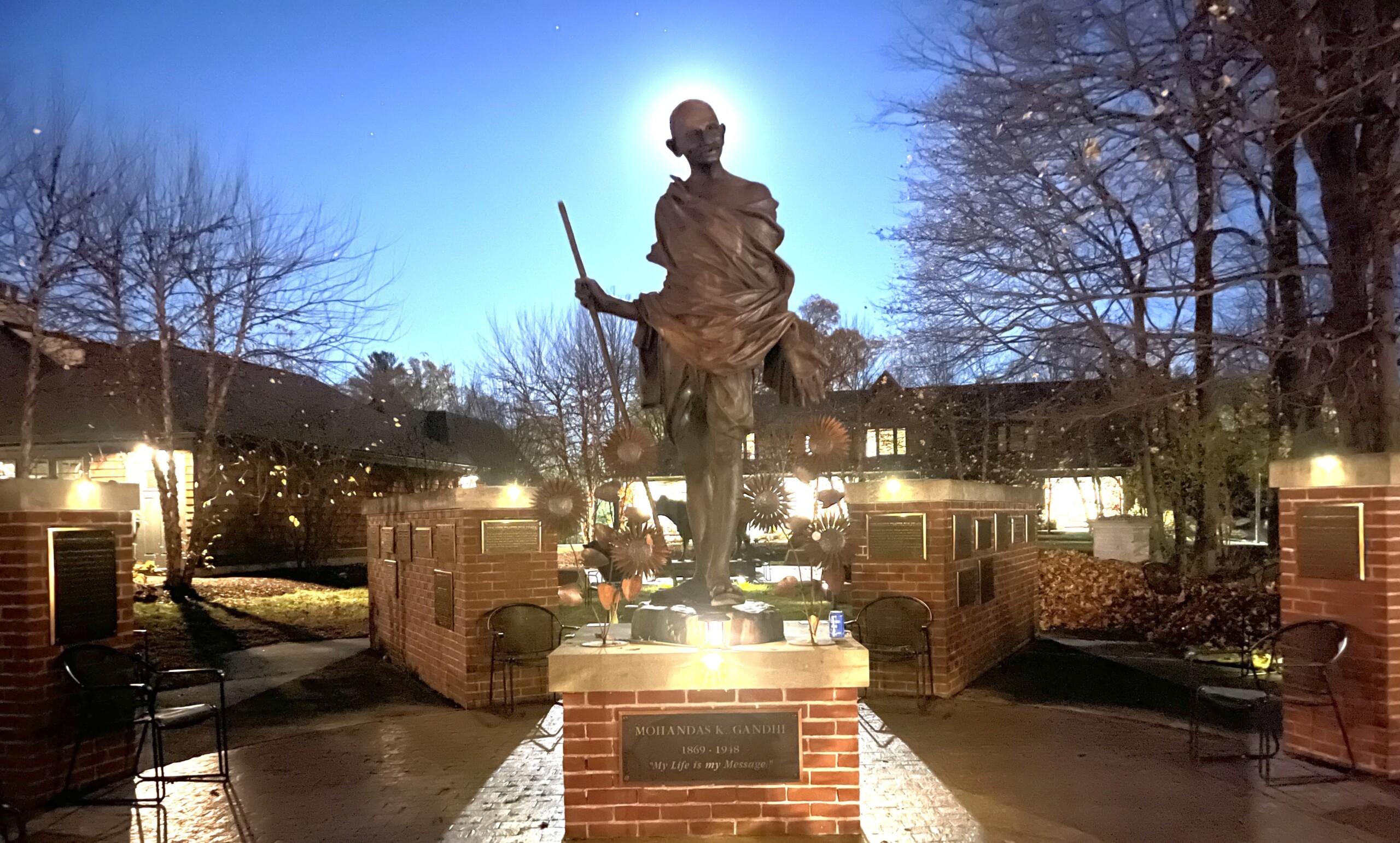
Gandhi statue at Peace Memorial Park in Sherborn. Photo courtesy Lewis Randa
Most people move through life remembering which famous person shares their birthday, and while that can be entertaining, my attention has always turned in another direction. I have found myself less interested in shared birth dates and more drawn to noting my age as it relates to fallen heroes.
Throughout my life, I have often reflected on my age alongside the ages of my mentors and heroes whose lives were cut short. I remember turning thirty-nine and thinking of Dr. King, whose life and dream were ended at the same age, and then turning forty-two and realizing that was as long as Bobby Kennedy was allowed to live before an assassin’s bullet ended his life and his 1968 campaign for the presidency. This way of relating to time has never felt abstract to me; it has been a particularly powerful reminder of how brief, precious, and vulnerable a life devoted to peace can be.
And now, reaching the age of seventy-eight gives me pause. It is the same number of years Gandhi was granted on Earth before an assassin’s bullet struck him down, and that fact has a special impact on me. Years ago, I traveled to the Birla House in New Delhi, India, stood near the very spot where he fell, and quietly promised myself that my own life would say, in whatever small way it could, that he did not die in vain. I vowed to take his teachings seriously and to be, among the millions who revere him, one more person who tries to carry his work forward.
That shared number of years is not just a coincidence of age; it feels like a mirror held up to my own journey. It invites me to ask how deeply Gandhi’s vision of nonviolence has pervaded my consciousness, and how faithfully I have tried to live it out through the mission of The Peace Abbey Foundation. No other person’s teachings have so profoundly shaped the course of my life.
Turning Peace Into A Lived Reality
What began for me as a young man’s moral conviction during the Vietnam War, which led to my discharge from the military as a conscientious objector, has, over time, become a deeply personal commitment to exploring how nonviolence can serve as a tool of resistance in our own time. It has meant organizing and conducting peaceful acts of civil disobedience when it was called for and, in my own imperfect way, letting peace be more than an idea, as I’ve tried to turn it into a lived reality.
Over the decades, that commitment has taken form in the work of honoring those whose lives embody Gandhi’s spirit: bestowing The Peace Abbey Int’l Courage of Conscience Award and creating Peace Memorial Park, where more than seventy-five peacemakers are remembered in bronze and stone. Each name there represents a thread in the same tapestry that I, and so many others of my generation, have tried to weave our lives into.
At seventy-eight, the very age at which Gandhi’s journey was cut short, I do not feel I’m anywhere near finished, but rather deeply aware of how unfinished the work of peace always is. Gandhi’s life reminds me that pacifism is not passive, and that nonviolence asks for real courage, the courage to hold fast to kindness when anger would be easier and shouting feels more satisfying. These are not abstract virtues; they are daily tests of character that I continually struggle to meet.
Is My Life An Example Of Non-Violence?
Here in Massachusetts, I’m reminded of this calling in places that have become part of my own journey: the bronze Gandhi statue at Peace Memorial Park in Sherborn, and the many memorials and installations inspired by the Peace Abbey’s work, spanning from this country to Ireland and England to Nagasaki, Hiroshima, and the DMZ in Korea. They feel less like monuments and more like questions: Am I living in a way that honors what this man stood for? If I were the only example of nonviolence someone ever saw, would they glimpse its moral authority and power? I suspect only barely, but even an imperfect expression, such as my own, is reason enough to keep trying.
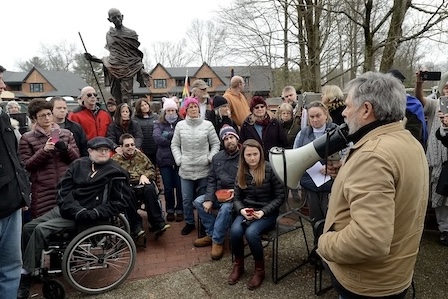
Lewis Randa organizing an action for peace at Peace Memorial Park.
At seventy-eight, I carry more gratitude than certainty that nonviolence will prevail, yet I live with the unshakable conviction that violence, its alternative, must be resisted, especially during this tumultuous period in American history.
May my seventy-eighth year be lived in the deep understanding that whatever good I am able to do owes, in no small measure, to the teachings of a man whose life briefly overlapped my own. I was but an infant, on the opposite side of the globe, four months old, when Gandhi was taken from us, yet I feel an enormous privilege in having shared even a fleeting moment in time with him on Earth.
Sharing a birthday is always something to note, but realizing you’ve reached the very age at which a mentor’s life was cut short touches me far more deeply. Those who died for peace lend their unfinished years to our own and call us to carry their purpose forward with whatever time we are given. They remind us that the work of peace is both inherited and renewed in each and every generation.
When all is said and done, may our life’s mission reflect the legacies of those we most revere, so that our own legacy may, in turn, become a part of theirs.
Lewis M. Randa is the Executive Director of The Peace Abbey Foundation.
Find holistic Spiritual Practices in the Spirit of Change online Alternative Health Directory.
RELATED ARTICLES:
It’s Time To Take A Stand
The Peace Abbey’s Journey Continues